
Compare
Spreadsheets calculate late. Schedulers show revenue. Otzaro shows product-level profit.
Cash-pay practices need three things most tools do not connect: inventory movement, point-of-service COGS, and margin per visit. Here is where spreadsheets, scheduling platforms, and Otzaro actually fit.
Profit proof
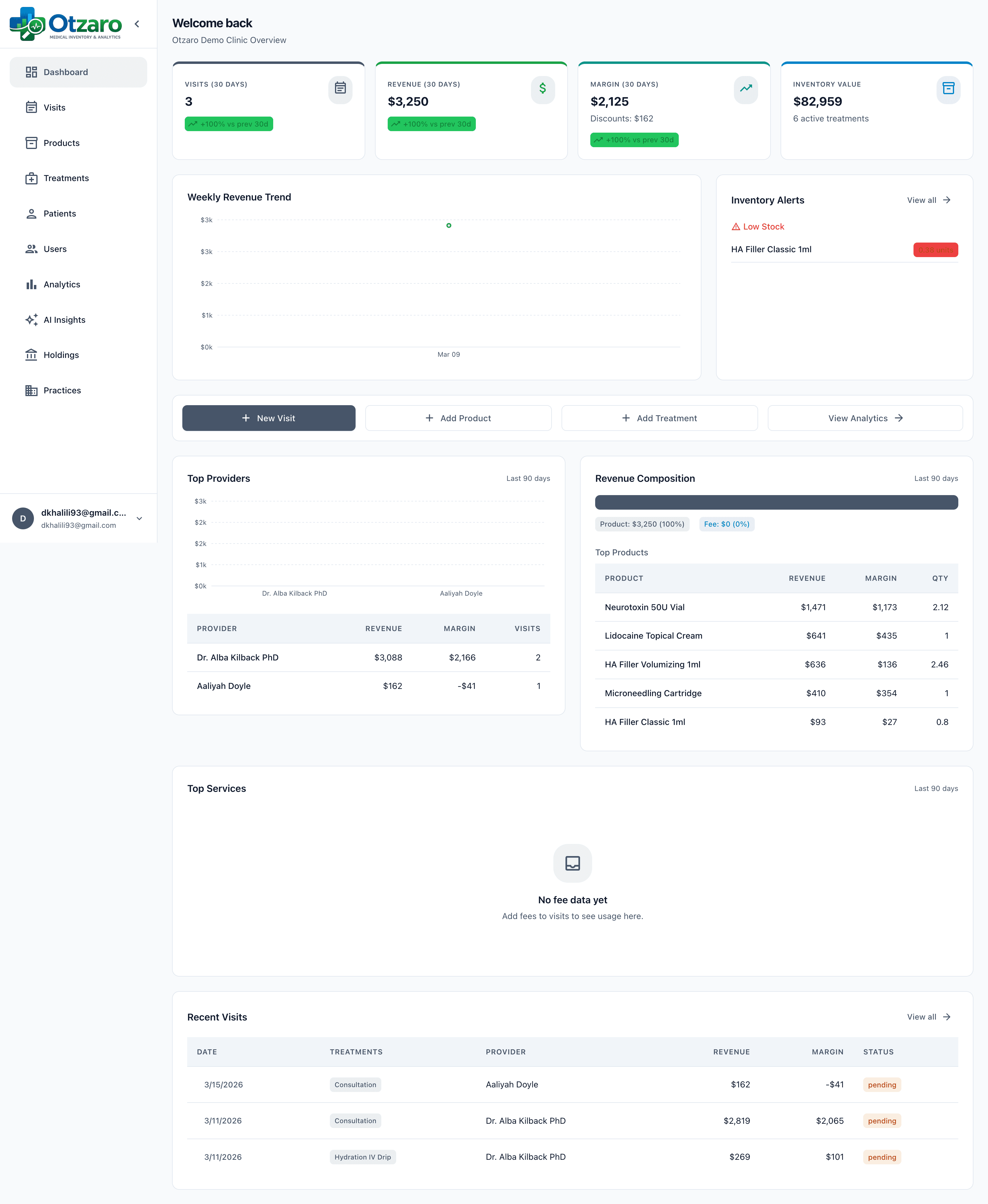
Revenue, inventory, and margin in one operating view
Revenue only answers what came in. Otzaro shows whether product-heavy services kept margin.
Side-by-side
Three tools. Three different jobs.
The mistake is expecting one tool to do all three jobs. Your scheduler should schedule. A spreadsheet can model. Otzaro is the operating layer for inventory, batching, ordering, COGS, and profit.
| Capability | Spreadsheet | Scheduling platform | Otzaro |
|---|---|---|---|
| Primary job | Manual tracking and after-the-fact calculations | Appointments, client records, payments, and revenue | Inventory, ordering, batching, COGS, and profit visibility |
| Inventory by lot and expiration | Possible, but fragile and rarely current | Usually not designed for lot-level clinical inventory | Native lot, batch, expiration, FEFO, and fractional usage tracking |
| COGS per visit | Estimated manually after service or month-end | Not the core model; revenue is visible, cost is not | Recorded at the point of service from the specific batch used |
| Ordering visibility | Static reorder sheets that depend on manual updates | Basic inventory counts at best | Low stock, reorder timing, usage trends, and expiration risk |
| Provider profitability | Manual reconciliation across usage, services, and payouts | Provider revenue or appointment volume | Provider profit based on actual product usage and service revenue |
| Margin per service | One-off model that goes stale as product costs change | Revenue reporting without product-level COGS | Live service margin based on actual cost and usage data |
| Waste and shrinkage | Usually discovered late, if at all | Not tied to visit-level product movement | Waste, expiration, and usage anomalies surfaced from operating data |
| Best fit | Tiny practice, very low product complexity | Booking, charting, client communication, and payments | Cash-pay practices where product cost decides profit |
Use a spreadsheet when
You have very few products.
You are willing to update inventory after every visit.
You only need rough estimates.
Provider-level profit does not matter yet.
Use scheduling software when
You need appointments, payments, and client records.
Revenue reporting is enough for the question being asked.
Inventory is simple or not a major cost driver.
You are not trying to calculate true COGS per visit.
Use Otzaro when
Inventory is a major part of your cost structure.
You need lot, batch, expiration, and fractional usage tracking.
You want margin per visit, service, and provider.
Ordering and waste need to be managed from actual usage.
Operator guides
The workflows spreadsheets usually fail to keep current.
These guides explain the operational details behind the comparison: COGS, lot numbers, GLP-1 medication inventory, and IV therapy supply usage.
The practical answer
Keep the scheduler. Retire the margin spreadsheet.
Otzaro is not trying to become your appointment book. It is the profit and inventory layer your appointment book does not have: the part that knows what product was used, what batch it came from, what it cost, and whether the service made money.
Scheduling platform
Appointments, client records, payment workflows, reminders, forms, and revenue reporting.
Otzaro
Product movement, lots, batches, reorder signals, point-of-service COGS, and profit per visit.
Together
Your team keeps the front-office workflow while owners get the product-level financial visibility needed to run the business.
Where spreadsheets fail
The spreadsheet is not wrong. It is late.
A spreadsheet can tell you what margin should have been if the data was entered correctly. Otzaro shows what happened as the work happens.
New lots arrive at different costs.
Partial vials move across visits.
Providers use different amounts.
Discounts change service economics.
Expired product becomes invisible shrinkage.
Ordering decisions happen before month-end.
FAQ
Common comparison questions.
Does Otzaro replace my scheduling software?
No. Otzaro works alongside scheduling platforms such as Pabau, Zenoti, Moxie, Jane, and Aesthetic Record. Your scheduler manages appointments and client workflows. Otzaro manages inventory, COGS, ordering, batching, and profit visibility.
Can a spreadsheet do what Otzaro does?
A spreadsheet can model COGS if someone keeps it current. The problem is operational: product costs change, providers use different amounts, lots expire, and usage happens during visits. Otzaro records that data in the workflow instead of asking someone to reconcile it later.
Why compare Otzaro to scheduling software if it is not a scheduler?
Because many cash-pay practices assume their existing practice management platform should answer profit questions. In reality, most of those tools show revenue well but do not provide visit-level COGS and product margin visibility.
See the difference
Stop asking revenue tools to answer profit questions.
The demo shows where Otzaro fits alongside your current tools and how it exposes margin leakage from inventory, batching, ordering, and usage data.